Take Course
CareerZone's Masters in BIM Training in Bangalore
Get Course Details on WhatsApp
BEST BIM TRAINING INSTITUTE IN BANGALORE
BEST BIM TRAINING INSTITUTE IN BANGALORE for Civil Engineers, Mechanical Engineers, Structural Engineers & Architecture Engineers with Real Time Projects.
Masters in BIM Training in Bangalore at Career Zone. Job-oriented BIM course covering Revit Architecture, Structure & MEP with real-time projects. Classroom & Online BIM training for civil, mechanical & Architectural engineers. Industry-focused curriculum, expert trainers & certification support.
COURSE OVERVIEW
What is BIM?
Building Information Modeling (BIM) A process, not just software, that integrates structural, architectural, and MEP (Mechanical, Electrical, and Plumbing) data into a central model.
With the increasing demand for BIM Engineers, BIM Modelers, and BIM Coordinators, skilled professionals are highly valued by construction companies, consultants, and multinational firms.
More than 3D: While it uses 3D models, BIM adds crucial data about materials, costs, and lifecycles, enabling simulation and analysis.
“I” in BIM: The “Information” component allows for data-driven decisions throughout the building’s lifecycle, from concept to demolition.
BIM vs. CAD: CAD focuses on 2D drawing and drafting (lines on a page), while BIM focuses on 3D modeling with data-rich, intelligent objects that understand their relationship with other objects.
Core Benefits of BIM
- Enhanced Collaboration: All stakeholders (architects, engineers, contractors, owners) work on a single, central model, improving communication and reducing errors.
- Cost Efficiency & Savings: Precise data allows for accurate material takeoffs (5D), reducing waste and controlling budgets.
- Clash Detection: Identifies conflicts between systems (e.g., HVAC pipes hitting structural beams) before construction, reducing costly on-site reworks.
- Better Visualization: 3D models allow stakeholders to "walk through" a virtual building to identify design flaws early.
- Improved Scheduling: 4D BIM adds time/scheduling data, allowing teams to visualize the construction sequence.
Popular BIM Tools & Software
- Autodesk Revit: Industry-standard for architectural, structural, and MEP modeling.
- Navisworks: Used for 3D model aggregation, clash detection, and coordination.
- Archicad: Popular with architects for 3D/2D modeling and rendering.
- Tekla Structures: Focused on detailed structural engineering and fabrication.
- Trimble Connect: Used for cloud-based collaboration and file sharing. [3, 4, 14]
- BIM Standards and Guidelines
- Level of Development (LOD) and Level of Information Need (LOIN)
Common Use Cases
- Architects: Designing, visualizing, and simulating daylight.
- Engineers: Analyzing structural loads and MEP systems.
- Contractors: Planning construction logistics and prefabrication.
- Facility Managers: Maintaining assets and monitoring building performance (Digital Twins).
Key Components of BIM
- 3D Modeling: Creation of detailed 3D representations.
- Parametric Design: Elements are defined by parameters and rules, meaning changes to one part automatically update related elements
- Common Data Environment (CDE): A centralized cloud-based platform where team members share and manage information.
- Interoperability (OpenBIM): Using standard formats like IFC (Industry Foundation Classes) to share data across different software applications. [2, 7, 9, 10]
BIM Levels of Maturity
- Level 0: No collaboration, 2D CAD only.
- Level 1: Mixed 2D/3D modeling, with separate, non-shared models for each discipline.
- Level 2: Collaborative, with each party using their own 3D model, but sharing data in a common, standardized format.
- Level 3: Fully integrated, cloud-based modeling where all parties work on a single, shared model.
BIM Dimensions
- 3D: Geometric model.
- 4D: Time/Scheduling.
- 5D: Cost Estimation.
- 6D: Sustainability/Energy Analysis.
BIM Coaching at Career Zone
Career Zone is recognized as a trusted BIM Training Institute in Bangalore, offering quality education with personal attention and flexible learning modes. Our goal is to make students industry-ready and confident to handle BIM projects in real working environments.
At Career Zone, we offer industry-oriented BIM coaching designed for students and working professionals who want practical, job-ready skills.
Our training focuses on real-time projects, hands-on practice, and professional workflows used in the industry.
Who Can Join This BIM Course?
✔ Civil Engineering students
✔ Mechanical & Electrical Engineering students
✔ Architecture students
✔ Diploma holders
✔ Working professionals in construction & design
✔ Freshers looking for high-paying technical roles
Career Opportunities After BIM Training
After completing BIM coaching, students can work as:
- BIM Modeler
- BIM Engineer
- Revit MEP Engineer
- BIM Coordinator
- Design Engineer (AEC Industry)
BIM professionals are in high demand in India, Middle East, Europe & other global markets.
BIM COURSE CONTENTS
DURATION : 6 Months
Module 1: Introduction to the BIM Dimensions
This module establishes the foundational “language” of BIM. It covers the transition from traditional CAD to a data-rich environment.
* 2D to 3D: Moving from flat drawings to parametric modeling.
* 4D (Scheduling): Integrating time and project sequences.
* 5D (Estimating): Linking quantities and costs to the model.
* 6D (Sustainability & Facility Management): Managing the building’s lifecycle and energy usage after construction.
Module 2: Software Training (Revit Ecosystem)
The “hands-on” phase where you learn to build the digital twin using industry-standard tools.
* Revit Architecture: Creating walls, floors, roofs, and aesthetic elements.
* Revit Structure: Modeling foundations, beams, columns, and reinforcement.
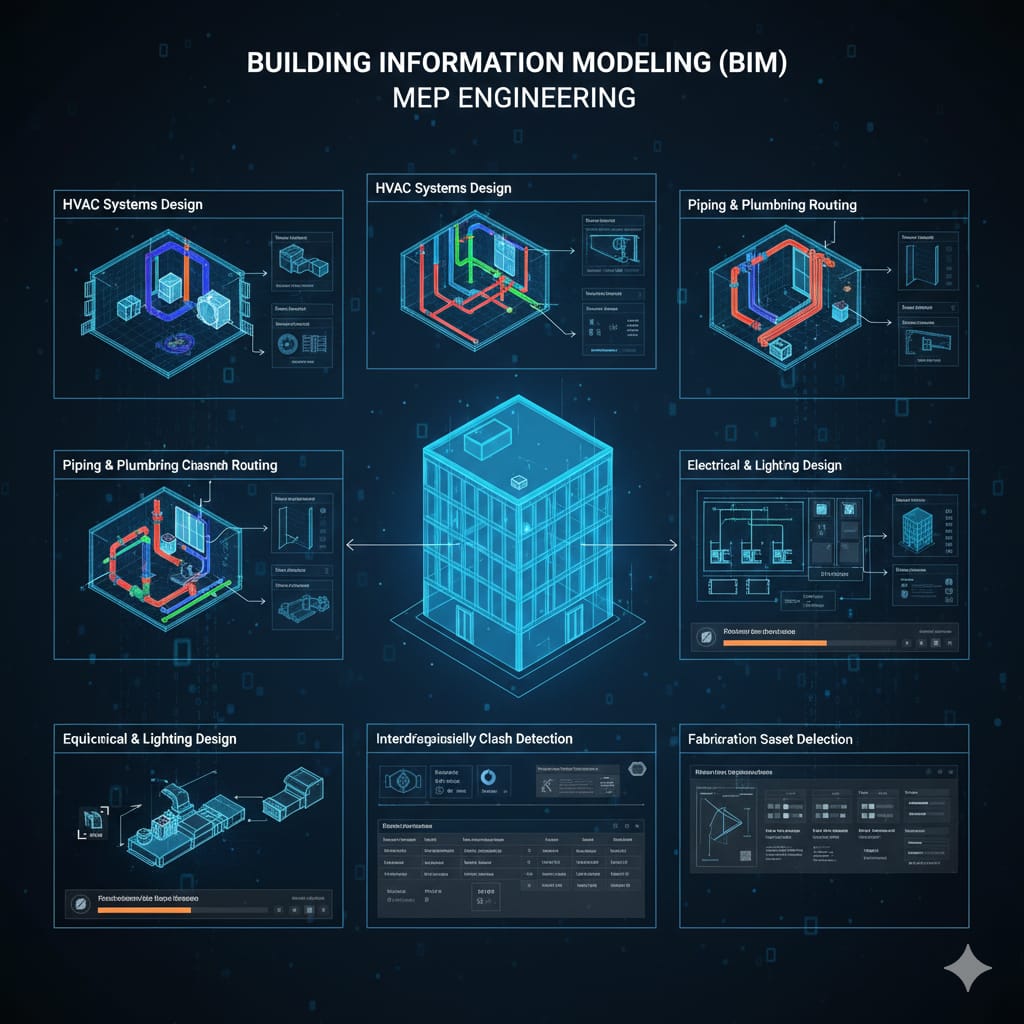
* Revit MEP (Mechanical, Electrical, Plumbing): Designing HVAC systems, piping, and electrical circuits.
* Clash Detection: Using tools like Navisworks to find spatial conflicts between disciplines.
Module 3: Project Work
Theory meets practice. You will execute a mini-project to simulate a real-world workflow.
* Template Creation: Setting up project coordinates and levels.
* Interdisciplinary Collaboration: Linking Architectural, Structural, and MEP models.
* Documentation: Generating floor plans, sections, and schedules directly from the 3D model.
Module 4: Level of Development (LOD)
LOD defines the “reliability” of the model at different stages of the project.
* LOD 100 – 500: Understanding the progression from a conceptual mass (LOD 100) to an as-built model (LOD 500).
* Model Accuracy: Determining how much detail is required for specific project milestones to avoid over-modeling.
Module 5: Standards & Regulations (ASHRAE & ISO)
BIM requires strict rules so that different companies can work together seamlessly.
* ISO 19650: The international standard for managing information over the whole life cycle of a built asset using BIM.
* ASHRAE Standards: Applying energy efficiency and ventilation standards (like 90.1 or 62.1) within the BIM workflow for MEP.
Module 6: BIM using Cloud (CDE)
Modern BIM happens in real-time across the globe using a Common Data Environment (CDE).
* Autodesk Construction Cloud (BIM 360): Hosting models in the cloud for live collaboration.
* Issue Tracking: Assigning “clashes” or design changes to team members digitally.
⭐⭐⭐⭐⭐ Trusted by Parents & Students Across Bangalore
Posted onTrustindex verifies that the original source of the review is Google. CareerZone is one of the best institutes for B.com coaching in Rajajinagar. The faculty ensures that every student understands the topics well.and the lectures are very friendly with all the students and this is the best institution for all students to grow their career Thank you Mahesh sir and thank you career zonePosted onTrustindex verifies that the original source of the review is Google. We noticed a big improvement in our child’s performance after joining the puc classes at Career Zone Coaching Institute. The coaching centre provides quality notes, disciplined teaching, and continuous monitoring. Highly recommended for parents looking for the best 2nd PUC Commerce tuition.Posted onTrustindex verifies that the original source of the review is Google. GoodPosted onTrustindex verifies that the original source of the review is Google. I have taken UGC NET PAPER 1 and paper 2 Computer Science coaching.With your hardwork and dedication, they will surely help and guide you to crack the exam.Posted onTrustindex verifies that the original source of the review is Google. “I am very happy with my B.Com coaching at Career Zone in Rajajinagar. The faculty teaches all B.Com subjects in a simple and exam-focused way, especially Accounting, Financial Management, and Taxation. Regular tests, chapter-wise notes, and doubt-clearing sessions helped me improve my marks & feature... Thanks a lot" Career Zone...Posted onTrustindex verifies that the original source of the review is Google. “My experience with BBA coaching at Career Zone, Rajajinagar has been excellent. The lecturers explain every BBA subject in a simple and practical way, especially Marketing Management, Financial Accounting, Quantitative Methods, and Business Law. Regular tests, notes, and doubt-clearing sessions helped me score better. If you are looking for the best BBA coaching institute or BBA tuition classes near Rajajinagar, Career Zone is the most reliable centre for strong academic results.”Posted onTrustindex verifies that the original source of the review is Google. Career Zone Coaching is the best BCom coaching centre in Rajajinagar, Bangalore. The faculty makes complex concepts simple with clear explanations. Regular tests and personalized attention improved my performance. Highly recommended for students preparing for BCom exams!Posted onTrustindex verifies that the original source of the review is Google. I enrolled for 1st PUC Commerce classes at Career Zone Rajajinagar, and the guidance has been excellent. The teachers cover every topic thoroughly and help us build strong fundamentals. The environment is very supportive and motivating. Truly the best place for PUC Commerce coaching in Bangalore!Posted onTrustindex verifies that the original source of the review is Google. The 2nd PUC Commerce coaching at Career Zone Coaching, Rajajinagar, has helped me score better marks. Their revision tests and doubt-clearing sessions are very effective. Teachers focus on both concept clarity and exam strategy. Perfect choice for students looking for commerce tuition in Bangalore!Load more
How to Get Admitted Into Our Courses?
The admission processes are very simple and straightforward. You can choose to apply through our website or you can call our faculty or admissions department to help you choose the right course.